Luxury cooking becomes truly meaningful when every ingredient has a purpose, and that is exactly where Scallops & Caviar stand apart. This pairing is not about excess; it is about balance, technique, and respect for premium seafood. Sweet, tender scallops provide a clean and delicate base, while caviar adds depth, salinity, and a refined finish that elevates the dish without overwhelming it. When prepared correctly, this combination delivers a restaurant-level experience using surprisingly simple methods grounded in culinary science.
Understanding how heat affects scallop proteins, when to introduce caviar, and how to balance fat, salt, and acidity is what separates an average plate from a memorable one. Scallops & Caviar work because their textures and flavors complement each other naturally, a principle supported by modern gastronomy and sensory analysis. This article focuses on practical techniques, ingredient selection, and professional insights that help you achieve consistent results at home or in a fine-dining setting. If you want to move beyond basic recipes and understand why this pairing works so well, continue reading for a clear, expert-driven breakdown.
The Science of Perfect Scallops: Achieving Texture and Flavor
Achieving perfectly cooked scallops is less about complexity and more about understanding food science. Fresh sea scallops are composed primarily of muscle fibers that tighten rapidly under excessive heat. The goal is to trigger the Maillard reaction on the surface while preserving a tender, slightly translucent center. This balance is what makes Scallops & Caviar such a refined pairing.
Professional kitchens emphasize high heat, low time, and moisture control. Scallops must be thoroughly dried before cooking; surface moisture prevents proper caramelization. A heavy pan—preferably stainless steel or cast iron—ensures even heat distribution.
Key scientific principles include:
Protein coagulation begins at ~40°C (104°F); overcooking leads to toughness
- Maillard browning occurs above 150°C (302°F), creating flavor depth
- Neutral oils with high smoke points protect scallop sweetness
When paired with premium roe such as Caviar by Pishva Holding, the scallop’s mild sweetness acts as a canvas rather than a competitor. The restraint shown in scallop preparation is critical; overly seasoned or butter-heavy scallops diminish the subtle complexity that defines high-quality Scallops & Caviar dishes.
Caviar: Understanding Quality, Flavor Profiles, and Handling
Caviar quality is determined by species, origin, processing method, and freshness. From Osetra’s nutty undertones to Baerii’s clean, mineral finish, each variety interacts differently with scallops. Understanding these profiles allows chefs to design Scallops & Caviar dishes with intention rather than excess.
Modern Caviar Market Trends show a shift toward sustainably farmed sturgeon, improved cold-chain logistics, and reduced salt curing (malossol), which preserves delicate aromas. These advancements have significantly improved consistency and accessibility without compromising quality.
Proper handling is non-negotiable:
- Store caviar between −2°C and +2°C (28–35°F)
- Avoid metal utensils to prevent oxidation
- Open tins just before service
Flavor pairing is based on contrast and harmony. Salinity enhances scallop sweetness, while fat content influences mouthfeel. A restrained portion of caviar should accent, not dominate. When handled correctly, caviar becomes a precision ingredient—one that elevates Scallops & Caviar from luxury to culinary logic.
Step-by-Step Luxury Recipe: Pan-Seared Scallops with Caviar Beurre Blanc
A successful Scallops & Caviar recipe relies on timing and restraint. This preparation uses classic French technique while respecting modern plating sensibilities.
- Step 1: Pan-Seared Scallops
Dry scallops thoroughly
Season lightly with salt only
Sear in clarified butter for 90–120 seconds per side
- Step 2: Beurre Blanc Base
Reduce white wine, shallot, and vinegar
Whisk in cold butter off heat
Maintain temperature below simmer
- Step 3: Final Assembly
Caviar is added after the sauce leaves the heat. This preserves texture and aroma. Portioning should follow accepted standards for caviar serving size per person, typically 10–15 grams for paired dishes.
| Component | Purpose |
| Scallops | Sweet, protein-rich base |
| Beurre Blanc | Fat and acidity balance |
| Caviar | Salinity and texture contrast |
This method ensures that Scallops & Caviar remain refined, not heavy, delivering clarity of flavor rather than richness overload.
Side Pairings That Complement Without Competing
Supporting elements in Scallops & Caviar dishes should enhance structure and balance, not draw attention away from the main components. The most effective sides focus on texture contrast, acidity, and subtle vegetal notes.
Recommended pairings include:
- Cauliflower or parsnip purée for neutral creaminess
- Asparagus or fennel for light bitterness
- Citrus-dressed greens to cut fat
Avoid starchy or heavily spiced sides. The goal is negative space on the palate—allowing scallops and caviar to remain the focal point.
| Side Type | Why It Works |
| Vegetable purées | Soft texture, mild flavor |
| Acidic salads | Refreshes palate |
| Steamed greens | Structural contrast |
When thoughtfully selected, side dishes reinforce the elegance of Scallops & Caviar rather than competing for dominance, a principle widely supported in fine-dining menu design.

Presentation and Plating: Visuals That Match the Taste
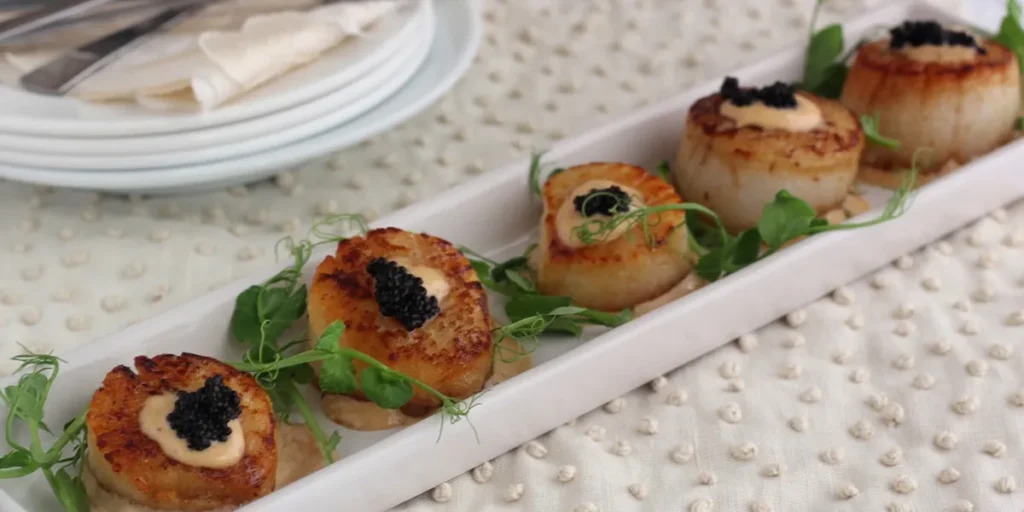
Presentation is not decoration; it is communication. In Scallops & Caviar dishes, plating should reflect restraint, precision, and confidence. Minimalism allows premium ingredients to visually justify their presence.
Key plating principles:
- Use neutral plates to highlight color contrast
- Position caviar last, ideally tableside
- Respect caviar serving temperature by avoiding warm surfaces
Microgreens, herb oils, or a light sauce smear can frame the dish without clutter. Height should be subtle; balance is preferred over drama.
Professional chefs often treat caviar like a finishing spice—placed intentionally, never scattered. Visual clarity mirrors flavor clarity, reinforcing why Scallops & Caviar are associated with high culinary standards rather than excess.
Common Mistakes and How to Avoid Them
Even premium ingredients can fail when mishandled. The most frequent mistakes in Scallops & Caviar preparation are rooted in misunderstanding technique rather than lack of skill.
Common errors include:
- Overcooking scallops, leading to rubbery texture
- Adding caviar to hot sauces
- Over-seasoning with salt or citrus
Avoid these by:
- Removing scallops from heat early
- Adding caviar only at plating
- Letting natural salinity do the work
Consistency comes from repetition and restraint. When mistakes are eliminated, Scallops & Caviar become reliable rather than intimidating, making them suitable for both professional kitchens and confident home cooks.
Final Takeaway: Why Scallops & Caviar Deserve a Place on the Plate?
True elegance in cooking comes from control, not complexity, and Scallops & Caviar perfectly illustrate this principle. When handled with precision, scallops offer a naturally sweet, buttery texture that requires minimal intervention. Caviar, when added at the right moment and in the right amount, enhances rather than dominates, providing contrast and depth that feel intentional instead of excessive. This balance is why the pairing has remained a staple in high-end kitchens across the world.
What makes Scallops & Caviar especially appealing is their versatility. The dish can be refined enough for a formal tasting menu or simplified for an intimate dinner, without losing its identity. Scientific understanding of heat control, fat emulsification, and flavor contrast allows cooks to replicate professional results with confidence. Avoiding common mistakes—such as overcooking scallops or warming caviar—protects both texture and nutritional value.
Ultimately, this pairing is less about luxury for its own sake and more about mastering fundamentals. When technique, timing, and ingredient quality align, Scallops & Caviar become more than a recipe—they become a statement of skill. With the right approach, this classic duo can consistently deliver flavor, elegance, and credibility on any plate.
FAQ
1. Is Scallops & Caviar suitable for home cooking?
Yes. With proper timing and temperature control, it is highly achievable at home.
2. How much caviar should be used per serving?
Typically 10–15 grams per person, depending on dish structure.
3. Can frozen scallops be used?
Fresh is preferred, but properly thawed, dry-packed frozen scallops can work.
4. Why should caviar never be cooked?
Heat destroys its texture, aroma, and nutritional integrity.
5. What makes this pairing so popular in fine dining?
Natural flavor contrast, textural balance, and visual elegance.